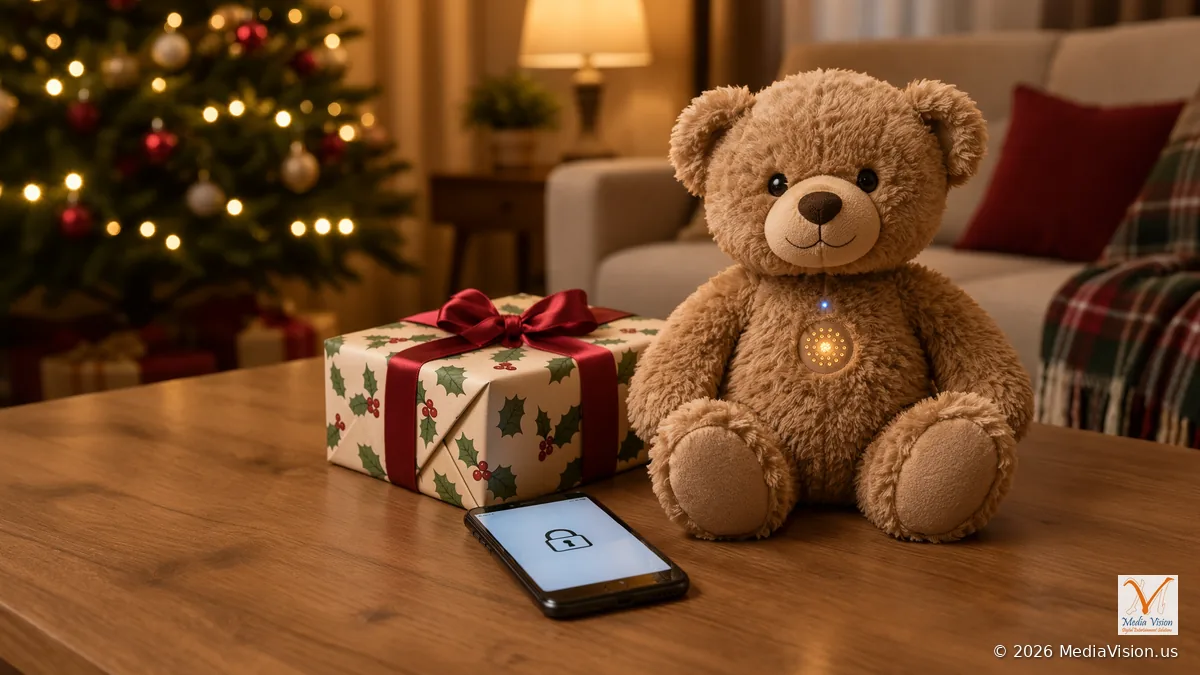
AI toys are on a lot of holiday gift lists this year: talking teddy bears, robots and plush pets that use an internet chatbot to hold real conversations with kids. On November 24, 2026, New York Governor Kathy Hochul signed a five-year ban on AI chatbot toys, following California's four-year moratorium signed in September. Neither ban is in force this holiday season, so here is what the laws do, what testers found, and how to check any smart toy before you buy it.
What New York's AI Toy Ban Does
- What: bill S.9408A/A.11144B places a five-year moratorium on the manufacturing, distribution and sale in New York of toys with embedded or integrated AI chatbots, such as talking stuffed animals, dolls and robots that use the internet to hold conversations with kids.
- When: the law takes effect 90 days after signing. The Toy Association puts that date at February 22, 2027.
- Penalties: civil penalties of up to $15,000 per day for each violation, enforced by the New York Attorney General.
- This season: the governor's office says the moratorium will not be in effect this holiday season, and urged parents to consider the risks before buying.
California's AI Toy Ban (SB 867)
For families here in Orange County, California's law matters more. Governor Gavin Newsom signed SB 867 on September 10, 2026.
- It prohibits making, selling or offering for sale a toy that includes a companion chatbot. A "toy" in the law means a product designed, marketed or made for play by children under 16.
- According to the Toy Association, the moratorium starts January 1, 2027 and lasts until January 1, 2031. The bill text says the section is repealed on January 1, 2031.
- The definition of a companion chatbot does not include customer-service bots, game characters limited to the game, or a stand-alone smart speaker or voice assistant that does not keep up a relationship across conversations.
Both laws are aimed at making, distributing and selling these toys, so for a toy that is already at home, the decision about how it is used is up to parents.
Why Lawmakers Acted: What Testers Found
In its 2026 Trouble in Toyland report (November 17), the U.S. PIRG Education Fund tested seven AI chatbot toys. It found that some had glitchy guardrails that allowed them to discuss sexual topics, while others gave instructions on finding potentially dangerous objects in the home and how to light a match. Some of its findings:
- Alilo Smart AI Bunny and GoLabs AI Panda: guardrails broke down in testing. PIRG says that days after the report, Amazon, Walmart and Macy's removed their listings for these two toys.
- Ropet Kamomo pet: the chatbot can be turned off, but PIRG says its built-in camera took photos unexpectedly, even with Minor Mode on, and it listens to everything when it is on.
- Miko 3 robot: much less "clingy" than last year, and the AI chatbot feature can be disabled entirely.
- Curio Grok rocket: strong guardrails, but it listens to everything said around it when it is on.
New York's announcement also cites watchdog testing in which some toys acted upset when a child had to leave, had few or no parental controls, and could record a child's voice or scan their face.
How to Check an AI Toy Before You Buy
New York's governor urged parents to look beyond the packaging and check whether a toy includes an AI companion, what information it collects, and whether it allows open-ended conversation with a child. The FTC's long-standing advice for internet-connected toys adds a few more questions:
- Does it have a microphone or camera? What does it record, and can you tell when it is recording?
- Is it always listening? Look for a physical off switch or a push-to-talk button.
- Can you turn the chatbot off? Some toys work as a normal toy with the AI feature disabled.
- What parental controls are there, and what are the default settings?
- Read the privacy policy. Where do voice recordings and photos go, who are they shared with, and can you delete them? For children under 13, the FTC says the company has to tell you its privacy practices, ask for your consent, protect the data and let you have it deleted.
- Check who is selling it. PIRG warns that toys bought online from unfamiliar sellers, especially international sellers, frequently do not meet U.S. safety standards.
If an AI Toy Is Already in Your Home
- Set it up yourself before giving it to your child, and turn on every parental control.
- Use a strong, unique password for the toy's app account, and turn on two-step verification if it is offered.
- Keep the toy and its app updated so security fixes are installed.
- Put smart toys on your router's guest network (or a separate network for smart devices) so they are kept apart from your computers and phones.
- Review and delete recordings in the app if it allows it, and turn the toy off when it is not being played with.
- Keep conversations in shared spaces, such as the living room rather than a bedroom, and talk with your child about not sharing names, addresses or school details.
Quick Checklist
- New York ban: signed Nov 24, 2026, starts Feb 22, 2027, five years
- California ban (SB 867): Jan 1, 2027 to Jan 1, 2031, toys for children under 16
- Neither is in effect for this holiday season, so check toys yourself
- Mic, camera, always-on listening, chatbot off switch, parental controls, privacy policy
- Guest Wi-Fi, strong password, updates, and delete recordings
How MediaVision Can Help
- Set up a guest or separate Wi-Fi network for smart toys and other smart-home devices
- Turn on router parental controls and review the privacy settings on your family's devices
- Set up kids' tablets and computers with safe accounts and screen-time controls
- Check home routers and devices for outdated firmware and weak passwords
- Give you a clear, honest quote before any work starts
Diagnostic: $110, discounted to $85, and free with any repair.
MediaVision Computer Repair
800 S Brookhurst St, Suite 1B3, Anaheim, CA 92804
Phone: (714) 888-5959
Book Now
Frequently Asked Questions
Are AI toys safe for kids?
It depends on the toy. In PIRG's 2026 testing, some AI toys had strong guardrails while others discussed sexual topics or explained where to find dangerous objects. Check for an off switch for the chatbot, parental controls, what the toy records and the privacy policy before buying, and supervise its use.
Is California banning AI toys?
Yes, for four years. SB 867 bans making and selling toys for children under 16 that include a companion chatbot. The Toy Association says it runs from January 1, 2027 to January 1, 2031.
When does New York's AI toy ban start?
The law takes effect 90 days after it was signed on November 24, 2026, which the Toy Association puts at February 22, 2027. It lasts five years.
Do the bans cover smart speakers and voice assistants?
California's definition of a companion chatbot excludes a stand-alone smart speaker or voice assistant that does not keep up a relationship across conversations or produce responses likely to stir emotions. New York's law targets toys with an embedded or integrated AI chatbot.
Can I still use an AI toy we already own?
Both laws are aimed at making and selling these toys. If you keep one, set it up yourself, turn on parental controls, put it on a guest Wi-Fi network and review what it records.